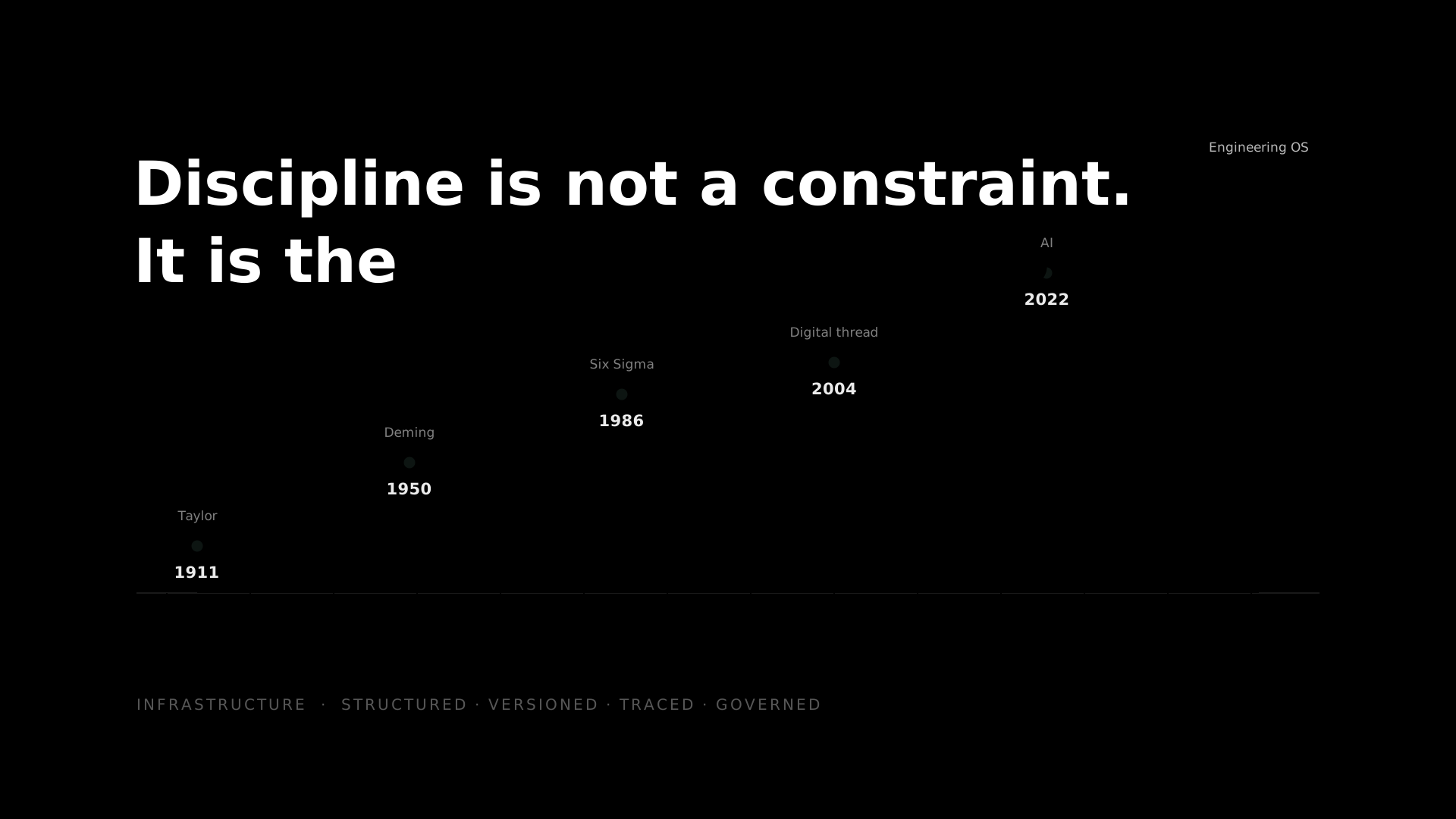
Discipline Is Not a Constraint. It Is the Infrastructure of Performance.
Prologue
Discipline has a reputation problem. It evokes rigidity, constraint, the opposite of agility. In innovation culture, it is often framed as the enemy of creativity. We prefer flexibility, rapid iteration, movement.
Yet since 1900, the highest-performing organizations in industrial history are also the most disciplined. Not disciplined in any military sense. Disciplined in their relationship to information, to data, to the structure of their operations.
This thesis is not ideological. It is empirical.
I. 1911. The birth of measurement as leverage
Frederick Winslow Taylor published The Principles of Scientific Management in 1911. The title is frequently cited as the starting point of modern management. What is forgotten is that his real contribution was not organizational. It was epistemological.
Taylor began with a simple observation: no one in the American factories of the early twentieth century actually knew what was happening. Output was approximate. Execution times were not measured. Working methods varied from one worker to the next. Decisions rested on the foreman's intuition.
His method, the time-and-motion study, decomposed every gesture into measurable units, recorded those measurements, and derived a standardized procedure from the collected data. Applied at Bethlehem Steel to the loading of pig iron, the results remain striking today: the number of workers required dropped from 500 to 140, with individual productivity multiplying by 3.6. This did not come from working faster. It came from working in a defined, measured, reproducible way.
In 1913, Henry Ford industrialized this principle at an unprecedented scale. The Highland Park assembly line reduced Model T assembly time from 728 minutes to 93 minutes between 1913 and 1914. Annual production rose from 19,000 units in 1910 to 734,000 in 1916. The retail price fell from $950 to $360 over twelve years. What made this possible was not machinery alone. It was the decomposition of the entire production process into a defined sequence of standardized, measurable operations, each assigned to a fixed station, each connected to the next through a precisely timed flow. Ford had not just mechanized production. He had structured information about production into a form that could be held constant, measured, and improved.
The lesson is not that Ford worked harder. He imposed a discipline of sequencing, of time, of work composition. Flow is the product of structure. Performance is the product of discipline.
It is important not to reduce Taylor and Ford to their historical context. The legitimate critiques of working conditions in that era do not invalidate the epistemological principle they identified: an organization that does not measure cannot improve. An organization that does not structure its operational knowledge cannot transmit it. Durable performance begins with the formalization of what produces performance.
II. 1950. Discipline as a corporate philosophy
World War II destroyed Japan's industrial base. In 1945, Japan imported nearly all of the manufactured goods it consumed. By 1980, it was the world's leading exporter of vehicles and consumer electronics.
W. Edwards Deming arrived in Japan in 1950, sent to support industrial reconstruction. He brought with him a method developed at Bell Laboratories by Walter Shewhart in the 1920s: Statistical Process Control (SPC). Shewhart's original insight was deceptively simple: variation in any process has two sources. Some variation is random and inherent to the process. Some variation is assignable to specific, identifiable causes. The discipline of quality begins with the ability to distinguish between the two. A process that confuses random noise with signal will correct for problems that do not exist and ignore the ones that do. The SPC chart, invented by Shewhart in 1924, was the first systematic tool for making this distinction in real time.
The JUSE (Union of Japanese Scientists and Engineers) adopted these principles broadly. Toyota, under the direction of Taiichi Ohno, formalized the Toyota Production System (TPS) between the 1950s and 1970s. The TPS is not a production method. It is a philosophy of data: every defect is a signal. Every signal deserves to be captured, analyzed, and converted into structural improvement.
In 1980, NBC broadcast a documentary titled If Japan Can... Why Can't We? that stunned American industry. The data were unambiguous: Toyota plants produced with a defect rate roughly 100 times lower than equivalent American facilities. The difference was not technological. It was architectural.
Fujio Cho, who would later become president of Toyota, put it plainly: "We do not make cars. We make data about how to make cars, and we improve that data continuously." That is the exact definition of what we call today an operating system.
The scope of this revolution extends beyond the automotive sector. It establishes a general principle: any organization whose processes are measurable can improve systematically. Any organization whose processes are not measurable advances only by accident. This principle applied in 1960 to vehicle production. It applies in 2026 to the production of engineering data.
III. 1986-1987. Discipline as a response to systemic catastrophe
The Western industrial response to Japanese dominance was first institutional. But two events gave it a different urgency.
On January 28, 1986, the Space Shuttle Challenger disintegrated 73 seconds after launch. The presidential commission identified a precise technical cause: the failure of the O-ring seals on the right solid rocket booster. But the systemic cause was different. Engineers at Morton Thiokol had raised concerns about this risk in writing. That information had not circulated.
Rogers Commission, Final Report, 1986: "NASA had a fundamental problem with communications. Critical risk information was available but was not reaching decision-makers."
The information existed. It was not structured to be used.
In 1986, Motorola formalized Six Sigma under the direction of Bill Smith. The objective was explicit: reduce process variability to fewer than 3.4 defects per million opportunities. This was not an improvement method. It was a measurement architecture that imposed, at every level of the organization, a precise definition of what counts as a defect and a method for tracking it.
In 1987, the International Organization for Standardization published ISO 9001. The standard required organizations to document their processes, maintain verifiable records, and demonstrate conformity of their outputs to defined requirements. At its creation, it was perceived as a bureaucratic burden. By 2023, more than 1.1 million ISO 9001 certifications were active across 188 countries.
That same year, NASA formalized its configuration management practices in NPR 7123.1. This was not coincidental. It was a direct response to Challenger: critical information must be in the system, in a form that is accessible, traceable, and governed.
This formalization extended a longer tradition. In 1970, during the Apollo 13 mission, an explosion damaged the service module 330,000 kilometers from Earth. All three astronauts survived. That rescue is often presented as a triumph of improvisation and human ingenuity. What is overlooked is that it was made possible by exhaustive documentation of the exact configuration of every system on board. Ground engineers knew precisely what was available, in what state, and in what configuration. Without that data discipline, there was no return trajectory to compute. Creative improvisation operated on an infrastructure of certainty.
IV. 1990-2003. The unfulfilled promise of digital
The 1990s brought the digital revolution to industry. Early ERP systems deployed across large enterprises. PLM tools (CATIA, Pro/ENGINEER, Unigraphics) became standard in aerospace and automotive. The promise was centralized data, traceability, and the end of paper.
In practice, the trajectory was different.
In 1994, the Standish Group published the Chaos Report on American software projects: 31.1% of projects were cancelled before completion. 52.7% finished over budget or over schedule. Just 16.2% were delivered on time and within budget. Digital had not resolved undiscipline. It had displaced it.
The rollout of Microsoft Excel, which accelerated with version 5.0 in 1993, created a structural regression. ERP centralized transactional data. Excel captured everything else: engineering calculations, traceability matrices, validation plans, working BOMs. By 2003, a PricewaterhouseCoopers study estimated that 90% of large organizations used spreadsheets for critical processes. 88% of those spreadsheets contained material errors.
Digital had multiplied the capacity to store information. It had not resolved the question of its structure.
This period also saw the emergence of early requirements management tools with IBM DOORS (1992) and the first PDM (Product Data Management) systems. These tools addressed a genuine need. But their adoption remained limited to large programs and large companies. For most engineering teams, managing complexity remained an exercise in improvisation. The spreadsheet was the universal tool not because it was effective, but because it was immediately available. Its mass adoption created a structural debt accumulating in silence.
V. 2004-2011. The cost of undiscipline at scale
Boeing experienced this at scale. The 787 Dreamliner program, launched in 2004, was the first aircraft designed under a radical global outsourcing model: 70% of value added was delegated to Tier 1 partners across 44 countries. The premise was that digital tools would enable coordination without a physical center.
The first flight, scheduled for 2008, took place in December 2009 after 26 months of delay. The program generated more than $32 billion in cost overruns. Internal investigations identified a central cause: data interfaces between Boeing and its partners were not defined rigorously enough. BOMs would not reconcile. Configurations evolved out of sync. Each partner maintained its own version of the truth.
The cost of data undiscipline was precise: $32 billion.
In 2009-2010, Toyota recalled more than 9 million vehicles worldwide over unintended acceleration issues. The direct cost exceeded $5.5 billion. The NHTSA investigation concluded that Toyota had insufficiently structured its processes for escalating field defect information. Signals had existed for several years. They were not in the system in an actionable form.
In 2011, McKinsey analyzed 401 large infrastructure projects representing a total investment of more than $6 billion. Projects exceeded their budgets by an average of 80%. Software projects recorded cost overruns of 200% and schedule delays of 70%. The structural cause identified in 65% of cases: the absence of reliable data during the project.
These figures are not isolated incidents. They define a structural condition of the industry.
The underlying mechanism is always the same. Complexity grows. Coordination requirements multiply. Informal data management practices that worked at smaller scale become load-bearing faults. The failure does not arrive abruptly. It accumulates through thousands of small misalignments: a BOM frozen in one team while another team keeps working from a previous revision, a change introduced verbally without formal record, a validation signed off without linking it to the requirement it addressed. None of these is catastrophic in isolation. Their aggregate is.
VI. 2015-2020. The aspiration toward a digital thread
The industrial response to these failures was first conceptual. The concept of the digital thread emerged in American normative literature in the mid-2010s, driven primarily by the Department of Defense and its Model-Based Systems Engineering (MBSE) initiative.
The INCOSE Systems Engineering Handbook, version 4.0 published in 2015, formalized the idea: the digital thread is the ability to connect, across the full lifecycle of a system, all engineering data in a coherent, traceable, and exploitable way. It is not a tool. It is an architectural property.
In 2016, the Government Accountability Office published a report on the data management system of the F-35 program. Lockheed Martin had invested $2.8 billion in this system (ALIS). The conclusion: ALIS did not provide sufficient traceability between the physical configuration of aircraft and their digital representation. At any given moment, it was not possible to know exactly what state each aircraft was in.
The digital thread was an aspiration. Realizing it demanded a data discipline that few organizations had actually built. The concept named the destination. It did not supply the infrastructure to reach it. That gap between aspiration and implementation is where most industrial organizations still sit in 2026.
The contrast between the Boeing 787 and the Airbus A350 illustrates this gap. Both programs launched at roughly the same time. The A350 XWB made its first flight in June 2013, two years behind schedule. The 787 had been three years late. The A350 was delivered to Qatar Airways in December 2014. The primary difference was not technical: Airbus had maintained a centralized configuration definition at every stage, with formally defined change control processes.
Architectural data discipline had produced 12 fewer months of delay on a $10 billion program.
VII. 2022-2026. Artificial intelligence exposes the structural fracture
On November 30, 2022, OpenAI released ChatGPT. Within five days, the platform reached one million users. Public debate focused immediately on the capabilities of language models: their ability to reason, to code, to write. That debate is secondary.
The real question raised by AI is structural.
Large language models are reasoning engines over unstructured data. They can read a document, analyze a report, answer a question posed in natural language. What they cannot do reliably is operate on critical engineering data without a structuring layer upstream.
The reason is precise: probabilistic reasoning over unverified data produces errors that are not detectable by the operator. In a non-critical context, such errors are acceptable. In an engineering context involving physical systems, they are not.
In 2023, Gartner estimated that 85% of enterprise AI projects fail to generate operational value. The primary cause identified: input data quality. This phenomenon has a name: the data readiness gap. It is not a question of algorithm. It is a question of data infrastructure.
In November 2024, Anthropic published the specification for the Model Context Protocol (MCP). This protocol defines a standardized interface for connecting AI agents to an organization's data sources. Its adoption by Microsoft, Salesforce, GitHub, and virtually every professional software publisher was near-instantaneous. Within six months, MCP became the de facto standard for interoperability between agents and information systems.
This moment marks something significant in the history of industrial discipline. For the first time, structuring data is no longer merely a competitive advantage. It is a condition of access to an entire class of tools. Organizations whose engineering data is structured, versioned, and exposed via defined interfaces can deploy agents capable of automating calculation, verification, traceability, and reporting tasks. Organizations whose data remains scattered across spreadsheets and unstructured documents cannot. Data discipline creates a bifurcation in technological trajectory. Organizations that invested in their data infrastructure before the arrival of agents hold a durable structural advantage. Those that did not must now build that infrastructure under pressure, with the costs that entails.
MCP is the formal confirmation of a thesis that took 120 years to fully articulate: the computational performance of a system is proportional to the structural quality of the data it operates on. An agent receiving an incomplete BOM makes incomplete decisions. An agent that cannot distinguish a validated revision from a draft produces analysis that conflates two states. The structure of data upstream determines the reliability of reasoning downstream.
This is not a question of computing power. It is a question of data discipline.
VIII. The thesis
From Taylor to GPT-4, the trajectory is consistent.
The organizations that have dominated their sectors for decades are not necessarily those with the best engineers, the best technologies, or the largest budgets. They are those that built an infrastructure of discipline: a capacity to capture, structure, connect, and exploit critical information in a reproducible way.
Toyota did not beat GM because its cars were technically superior in 1970. It was because its production system was architecturally superior in its capacity to process information about its own failures.
Boeing did not lose $32 billion on the 787 because its engineers were incompetent. It was because its data architecture could not support the level of coordination that its business model required.
Challenger did not disintegrate because no one knew the risk. It was because that knowledge was not in the system in a form accessible to decision-makers.
There is a constant across these three cases: performance had been built. And it collapsed not because competence had disappeared, but because the infrastructure that made it operational had been neglected or bypassed. Discipline is not a natural state for organizations. It is the product of a deliberate architectural decision. It does not sustain itself. It must be maintained, governed, and tooled.
The fragility of organizations that depend on spreadsheets and informal exchanges is not a problem of will. It is a problem of infrastructure. And like all infrastructures, it is only visible when it fails.
The question for an engineering team in 2026 is not: "Do we have the skills to build complex systems?" The answer is almost always yes.
The question is: "Is our data infrastructure equal to the complexity of what we are building?"
For most teams, the honest answer is no. Not from lack of ambition, but because building an infrastructure of discipline is systemic work that requires treating engineering data as a first-class asset: structured, versioned, traced, governed.
This work is not optional in 2026. It is the prerequisite for performance at scale. The systems we build have become too complex to coordinate any other way. The regulations that govern them demand traceability that informal tools cannot provide. The audits that validate them require a chain of evidence that no spreadsheet can reliably maintain across a product lifecycle measured in years. And the AI agents that will operate on this data in the months ahead will only generate value if the data they receive is trustworthy.
Discipline is not a constraint.
It is the ground on which performance is built.
This thesis is at the core of what we are building at Koddex: an [Engineering Operating System](/glossary/engineering-operating-system) that enables engineering teams to structure, version, and trace their critical data, so that their current tools and future agents operate on a shared, verifiable reality.