News
Deployment Record: install more systems a year with the same team

Special machines, robots, production lines, warehouse systems, energy storage: at a manufacturer that installs its systems at its customers' sites, every sale becomes a project to configure, deliver and commission. Koddex opens a module dedicated to that precise moment, the Deployment Record, so that project teams deliver more sites without growing at the same pace as the order book.
Growth that is paid for in hiring
Operations leaders know the paradox well. The order book grows, customers sign new sites, and every additional project calls for one more project manager, application engineer or commissioning engineer. The project team does not scale: it adds up.
The cause has less to do with skills than with the way information travels. A project starts with a specification, then goes through a specific configuration, a bill of materials, workshop tests, shipping, installation and acceptance. At each of these steps, part of the engineers' time goes into finding the right version, checking the requirements and producing documents. That time appears in no schedule, but it shows up in the headcount.
The delivered system, blind spot of the existing tools
Manufacturers do not lack tools. The PLM manages the generic product and its changes. The ERP tracks the order, purchasing and the invoice. The scheduling tool tracks tasks and milestones. Each does its job well, but none follows the object that matters to an operations leader: the system actually delivered at each customer, from the order to the installed base.
| Tool | Generic product | Order and costs | Tasks and schedule | Project requirements | Delivered system, site by site |
|---|---|---|---|---|---|
| PLM / PDMWindchill, Teamcenter, Vault | Tracked | Not tracked | Not tracked | Partial | Not tracked |
| ERPSAP, Sage, Divalto | Partial | Tracked | Not tracked | Not tracked | Not tracked |
| SchedulingMS Project, Jira, Monday | Not tracked | Not tracked | Tracked | Not tracked | Not tracked |
| Excel and shared filesOne copy per project | Partial | Partial | Partial | Partial | Partial |
| KoddexPlugged into the existing tools | Partial | Partial | Partial | Tracked | Tracked |
- Tracked
- Partial
- Not tracked
Koddex replaces none of these tools: it connects to them and adds what was missing, the system actually delivered at each customer.
That gap is filled by hand. The file of the previous project is copied, then corrected. Tracking spreadsheets are consolidated at the end of the week. A good part of the knowledge rests on a few experts who hold everything in their heads, which makes every departure or absence expensive.
The consequences surface late. A commissioning that slips is often discovered on site, when the penalties are already running and the project margin has started to melt. And when the executive committee asks what is installed where, in which version, the answer takes days.
What the Deployment Record does
The Deployment Record manages every system sold as a unique instance. That instance is linked to the project, to the customer's requirements, to the components and versions actually delivered, then to the interventions that follow commissioning.
On that data, AI agents take over the repetitive work. From the specification and the company's validated templates, they prepare the project configuration, trace the requirements and produce the files. Before each validation, they check that the system matches what was sold. The teams review, correct if needed and validate: they no longer write.
The design office, the project team, the partner installers and the subcontractors work on the same reference version. Each one reaches what concerns them, with rights per role and per partner, and every change is logged. The progress of a project no longer comes from a table filled in by hand: it is read in the actual state of the configuration, the validations and the reserves lifted.
Finally, Koddex replaces no tool. The platform plugs into the ERP, the PLM, the CAD, Excel and Drive, with no migration and no retyping. It adds the layer that was missing between them, the layer of the delivered system.
What it means for a team of ten engineers
The first effect is measured in capacity. For a team of ten engineers, the time the agents return represents the equivalent of two FTE. That time goes back to projects rather than to documentation.
10 engineers in the project team
The equivalent of 2 FTE returned to projects
For a team of 10 engineers, the time the agents return on the configuration, the checks and the documentation of projects. Our own calculation, from the 2 hours a day measured at Exotec; we redo it on your team.
For an operations leader, the gain reads in the indicators they already follow: more installations a year at constant headcount, a shorter lead time between the order and commissioning, fewer reserves at acceptance and therefore fewer penalties. Growth is absorbed without hiring at the same pace. Dependence on the historical experts also goes down, because the configuration rules live in a shared model rather than in a few heads.
An approach proven at Exotec
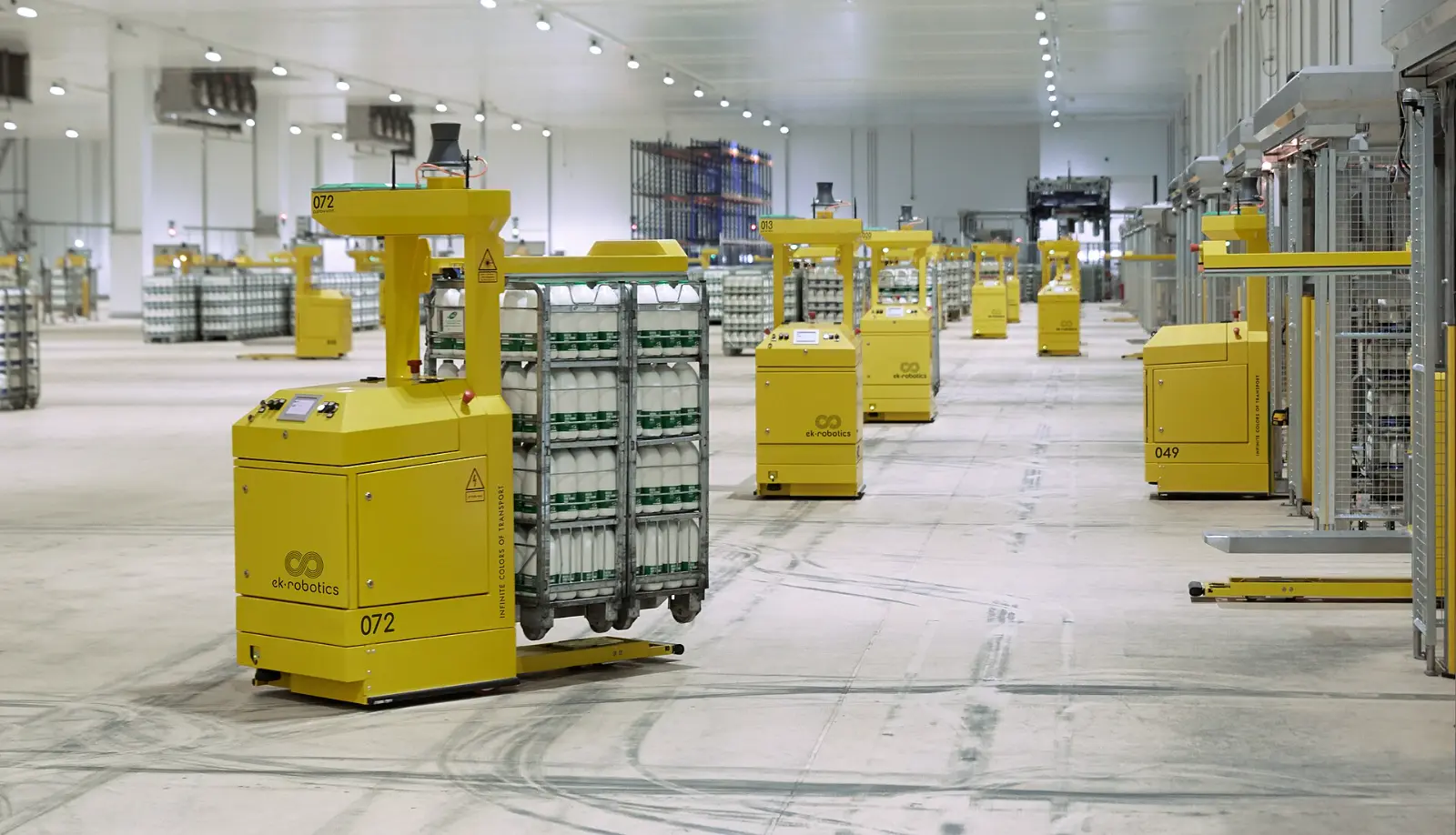
Exotec, the French leader in warehouse robotics, deploys its systems at its customers with a network of partner integrators. Every site deployment is traced in Koddex, from the project configuration to commissioning, then in the management of the installed fleet.
- ≈ 1,000
- people at Exotec and its partners work in Koddex
- 20
- partner organisations in the same model
- −30 %
- of time to market on a new product
−50 % and −30 %: ranges observed on guided deployments, not an audited average. The other figures are counted at Exotec.
For which manufacturers
The Deployment Record is for European manufacturers and integrators that sell a system configured per project, then install and commission it at their customers. The sectors where this model is most marked are intralogistics and warehouse automation, industrial robotics, special machines and production lines, packaging and food processing, airport systems, energy storage and hydrogen.
What these companies have in common: several installations a year, projects run in parallel, partners or subcontractors on site, and product versions that change from one installation to the next.
Where to start
The simplest is to start from a real project. The Koddex team models one of the company's past projects in the platform, with its requirements, its configuration and its documents, in about three days of data integration. The teams then see their own deployment traced end to end, and measure on a concrete case the time returned to their engineers.