Use case · pre-sales and engineering
Answer a tender in an hour, not in days.
A 42-page specification and 15 days to answer. A pre-sales agent reads it in Koddex, finds the catalogue product whose gaps can be closed and simulates the sub-part that closes them. Your engineer reviews each step and keeps the decision.
Simulated scenario made by Koddex · the figures are the film's
The three questions behind every tender
Which catalogue product meets the requirements?
Which requirements aren't met?
Can we adapt an existing product instead of designing a new one?
Step by step
01Step 1 · Specify
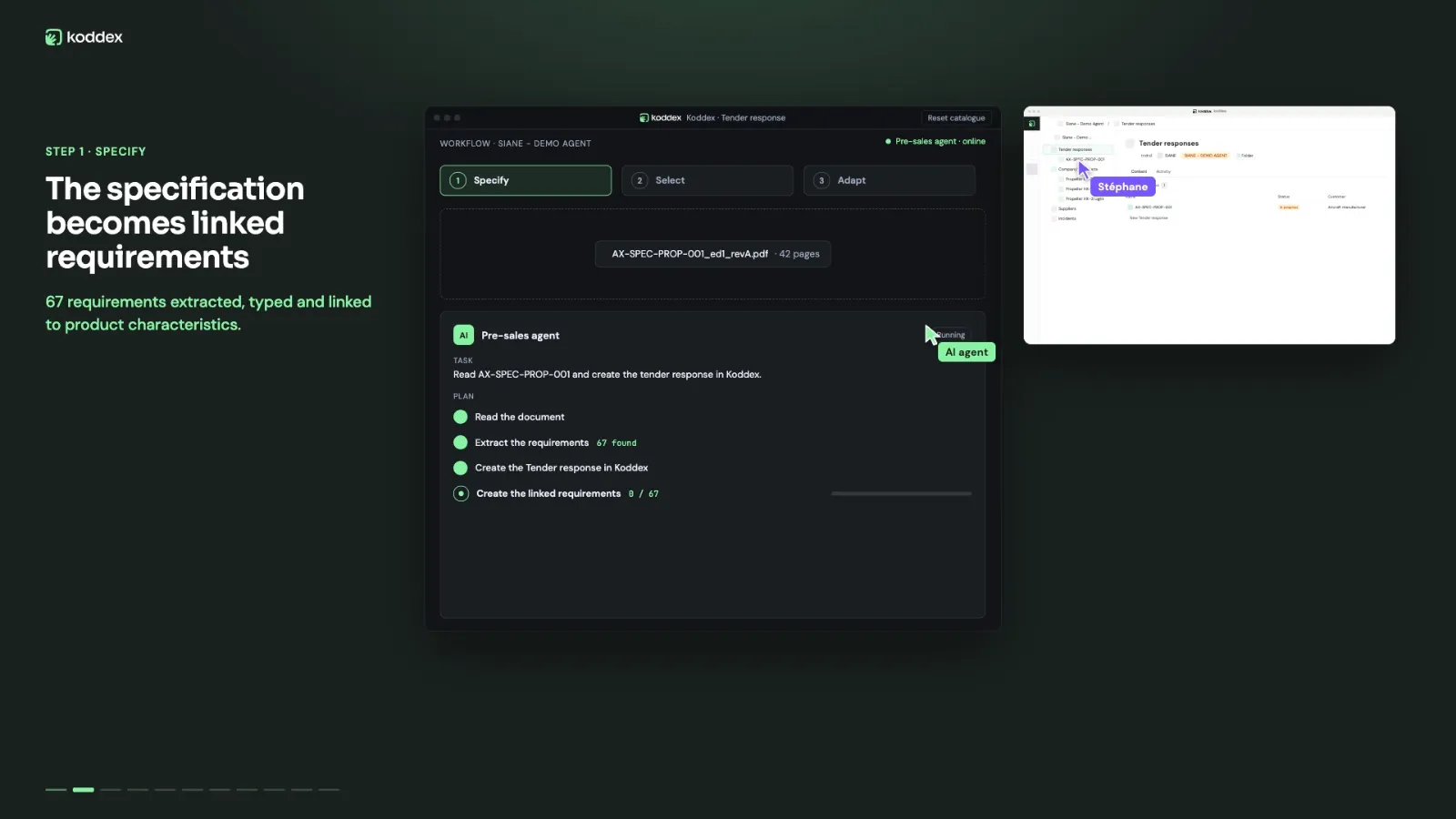
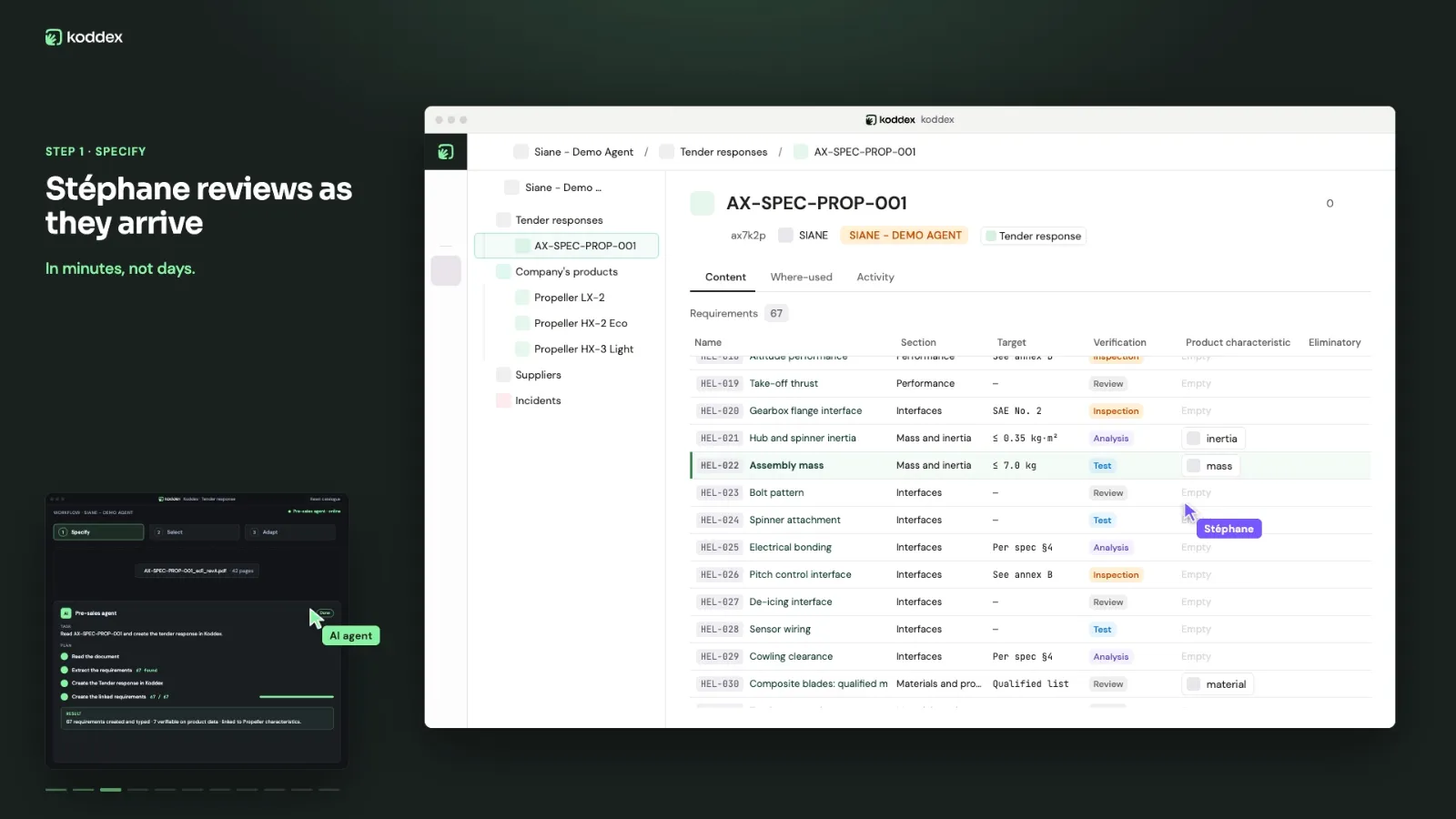
The specification becomes linked requirements
The agent reads the specification of a wing-mounted propeller, extracts 67 requirements, types them (performance, interfaces, mass and inertia, materials) and links each one to a product characteristic. The engineer reviews them as they arrive in the tender response: in minutes, not days.
The agent's plan
- Read the document42 pages
- Extract the requirements67 found
- Create the tender response in Koddex
- Create the linked requirements67 / 67
02Step 2 · Select
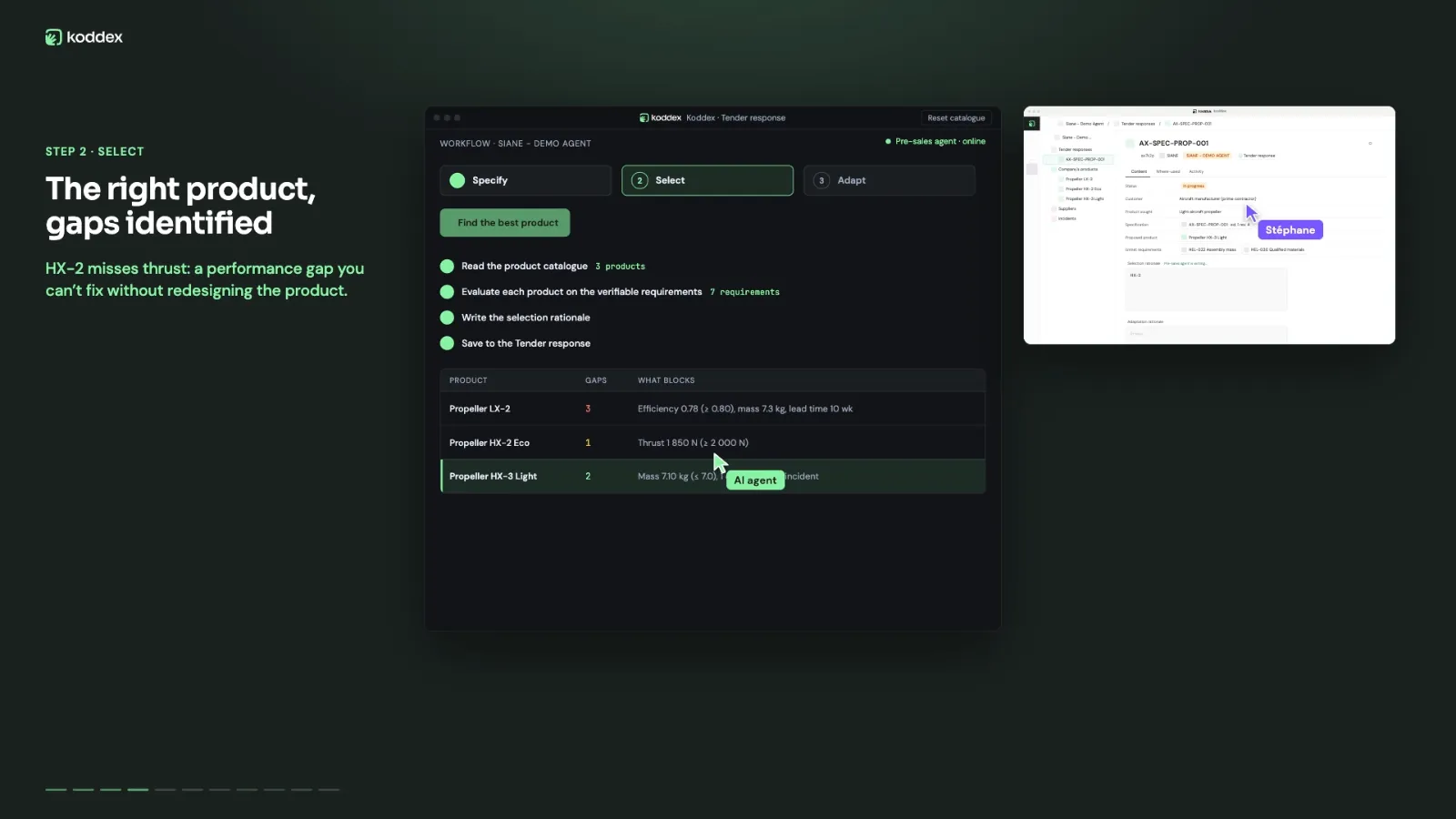
The right product, gaps identified
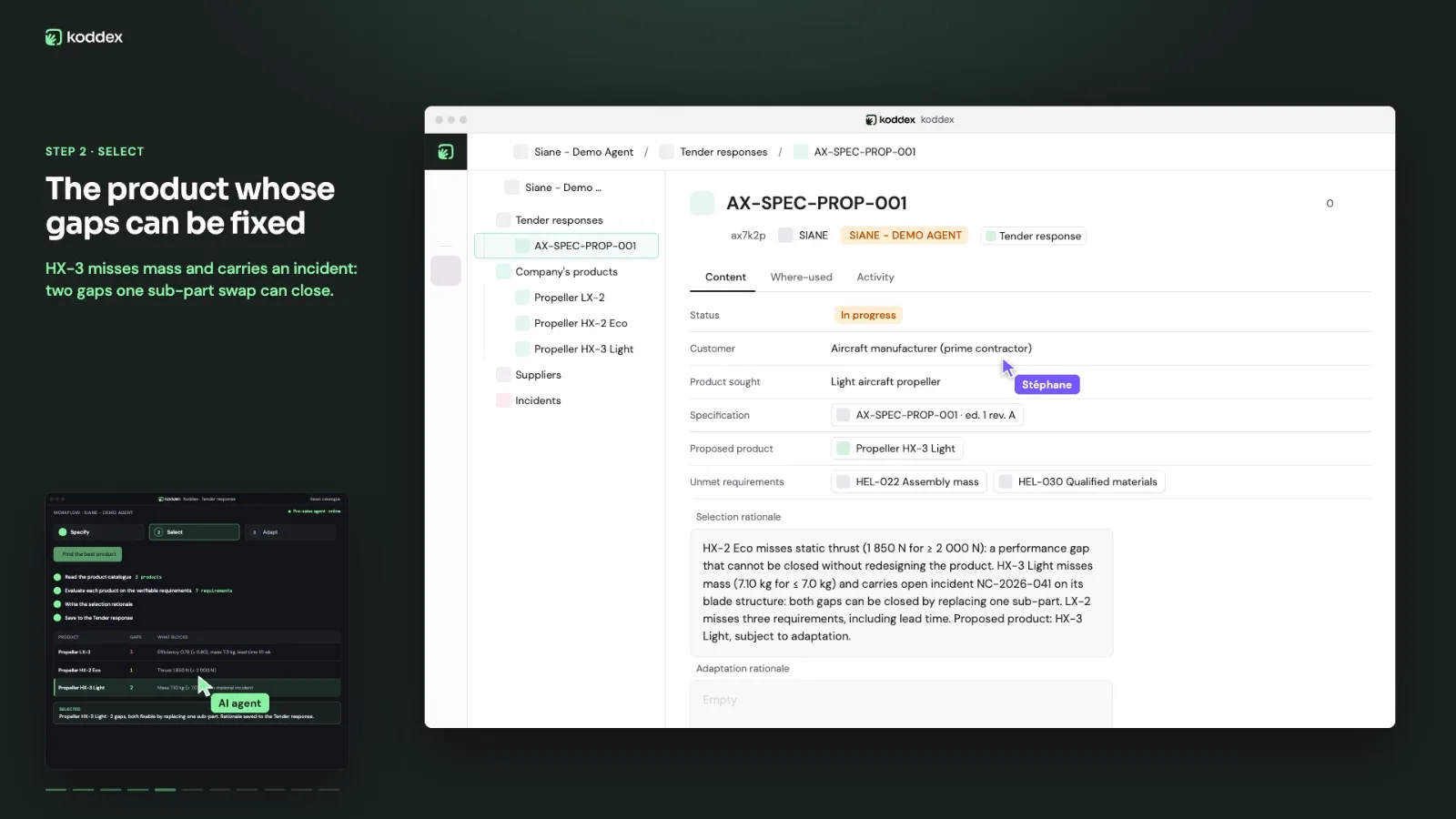
Each catalogue product is evaluated on the verifiable requirements. HX-2 Eco misses static thrust: a performance gap that would need a redesign. HX-3 Light misses mass (7.10 kg for 7.0 kg at most) and carries an open material incident: two gaps one sub-part swap can close. The agent writes the selection rationale into the tender response.
The agent's plan
- Read the product catalogue3 products
- Evaluate each product on the verifiable requirements7 requirements
- Write the selection rationale
- Save to the tender response
03Step 3 · Adapt
Replace the sub-part that blocks
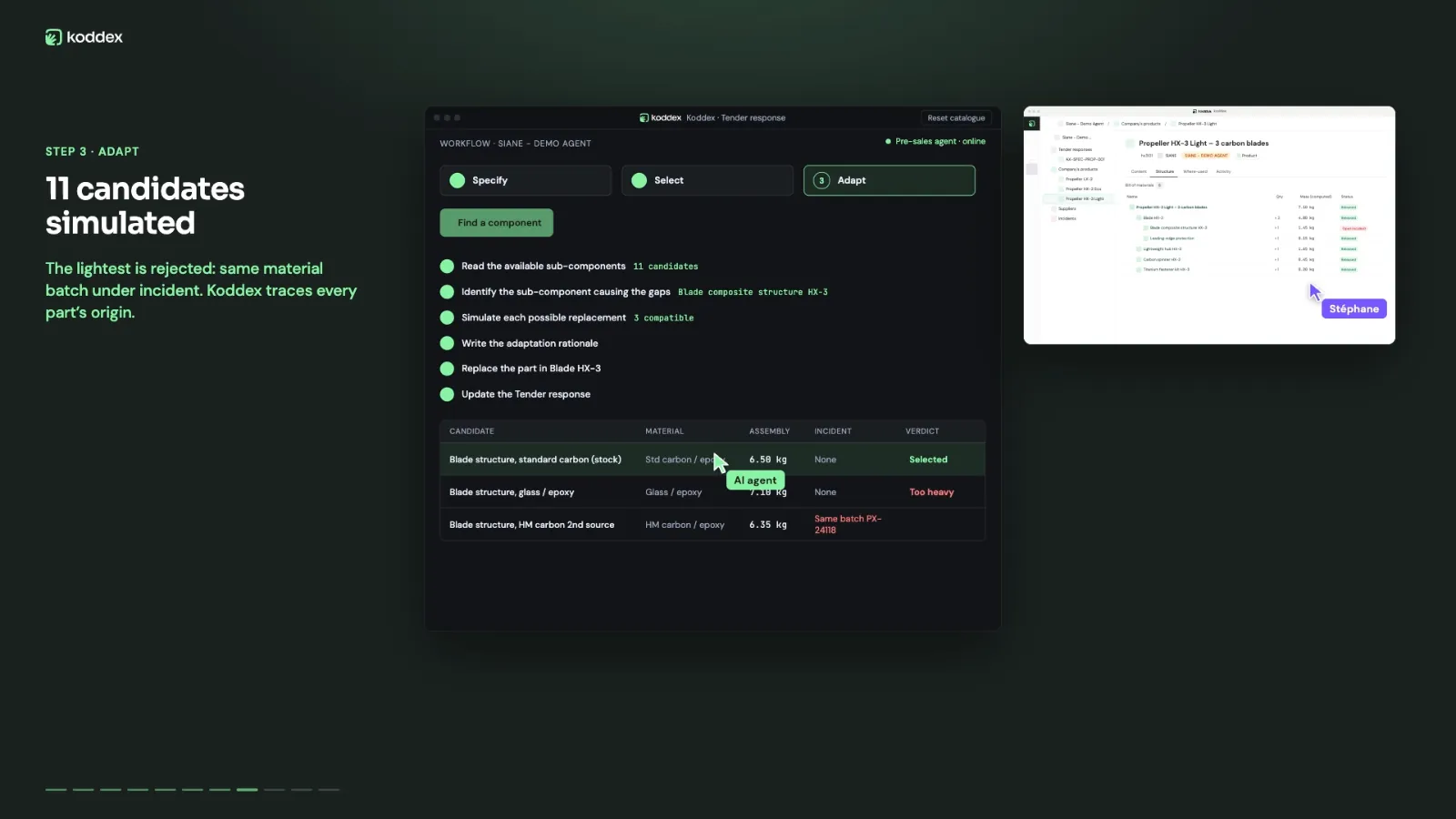
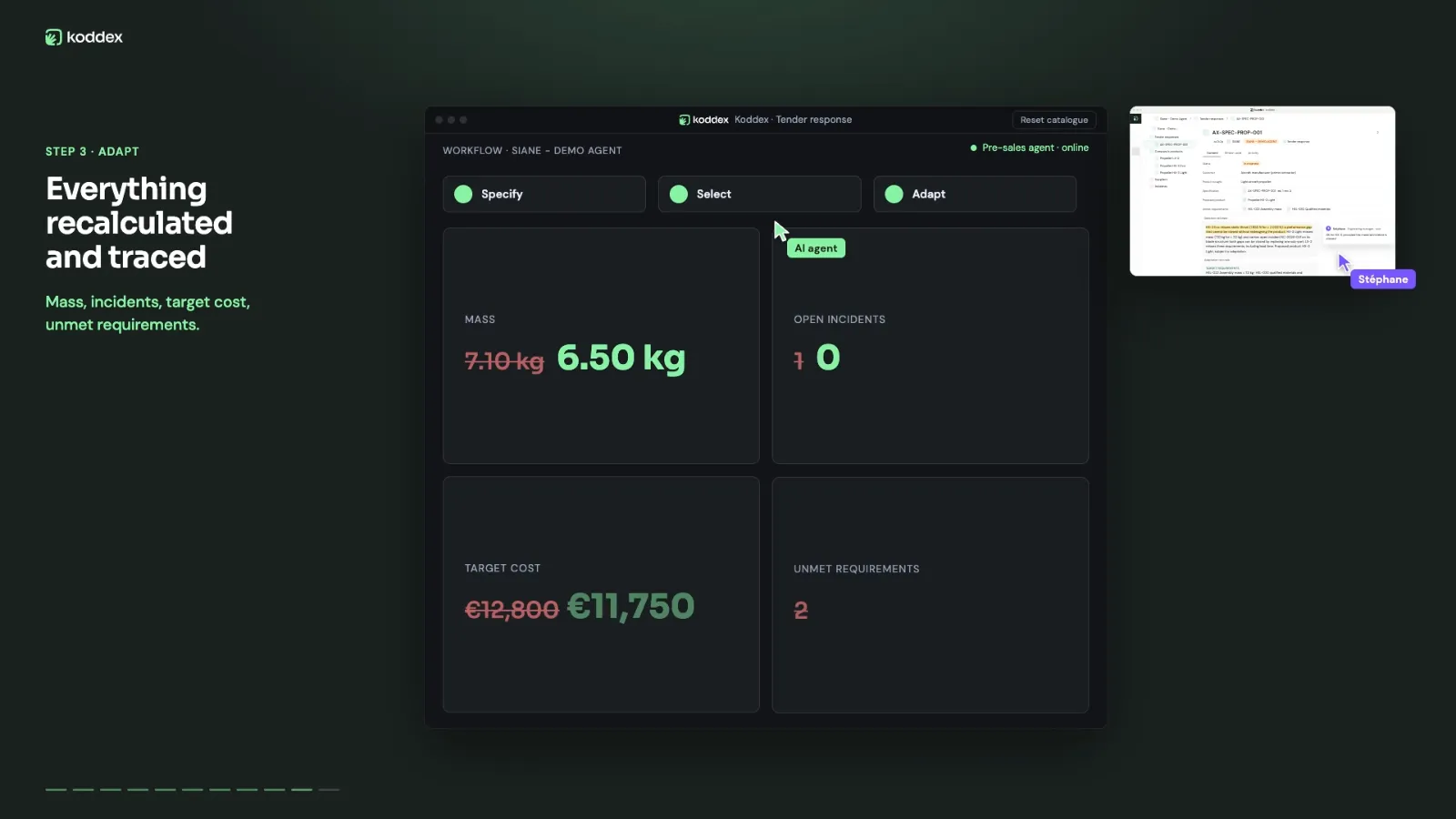
One sub-part causes both gaps: the blade composite structure. The agent simulates 11 candidates and rejects the lightest, which comes from the same material batch as the open incident: Koddex traces every part's origin. It selects a standard carbon structure in stock, and mass, incidents and target cost are recalculated through the BOM.
The agent's plan
- Read the available sub-components11 candidates
- Identify the sub-component causing the gaps
- Simulate each possible replacement3 compatible
- Replace the part and update the tender response
Mass
7.10 kg6.50 kg
Target cost
€12,800€11,750
Open incidents
10
04Validation
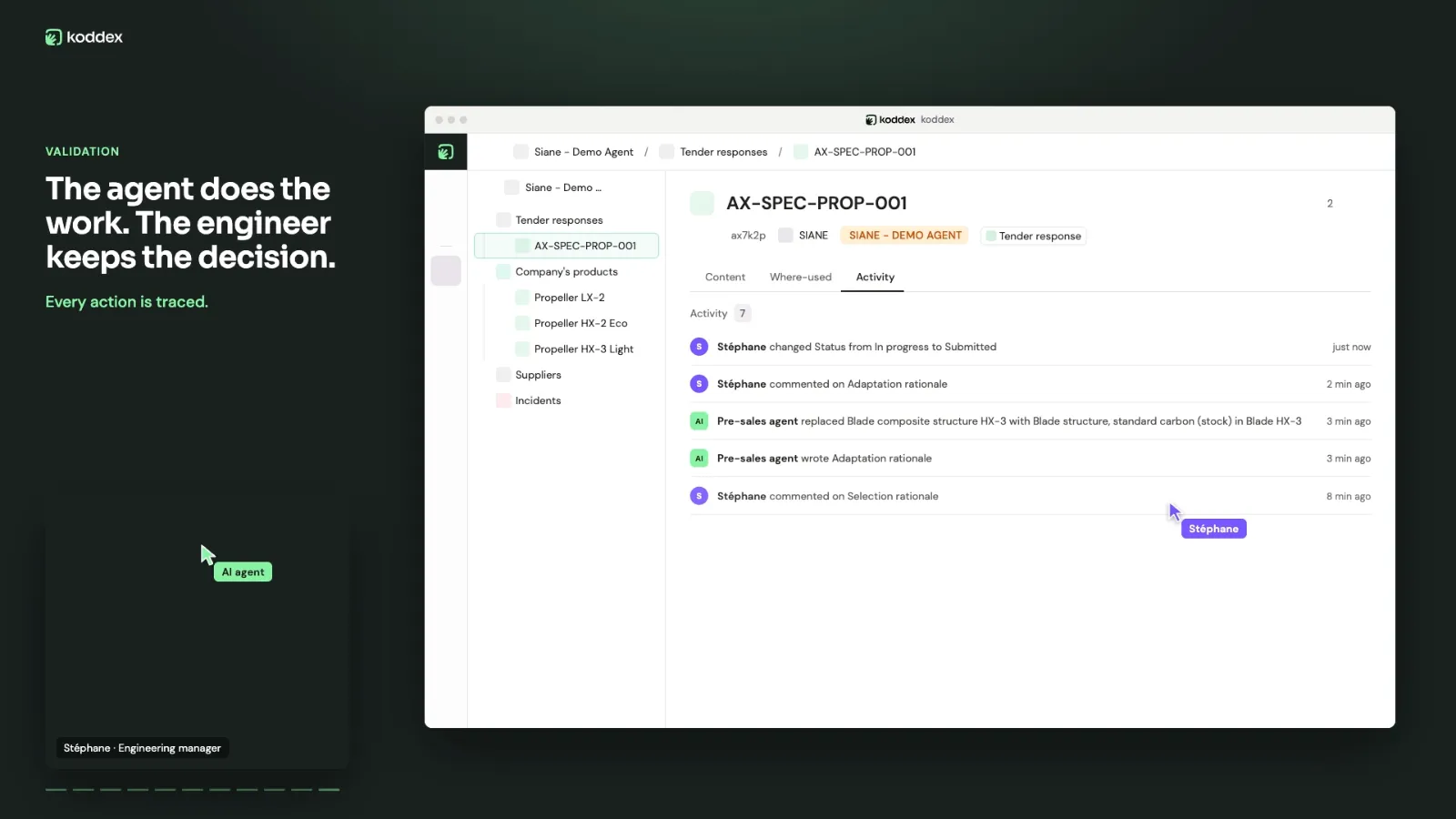
The agent does the work. The engineer keeps the decision.
Every action of the agent and every comment of the engineer sits on the tender response's activity. The engineer comments the rationales, then changes the status to Submitted.
What it changes
From specification to an argued response, in a single source of truth.
The tender is answered from the products you already make, with every requirement, choice and recalculation linked in Koddex.
Answer in minutes, not days
Requirements are extracted, typed and linked while the specification is read.
Reuse before you redesign
The catalogue is evaluated on the verifiable requirements, and the gap one part swap can close is found before anyone starts a new design.
Every answer argued
Selection and adaptation rationales, recalculated mass and cost, all linked to the requirements they answer.
The engineer keeps the decision
The agent executes, the engineer validates, and every action is traced.
A 20-min demo. Your first use case live in 1 month.
Bring one of your tenders to the demo. We run it in Koddex on a product like yours.